Illegal Alien or Immigrant the Politics of Immigration Reform Review
From Ballotpedia
Jump to: navigation, search
| |
| |
|---|
| |
| |
| |
 |

The Illegal Immigration Reform and Immigrant Responsibleness Act was passed by Congress in 1996 and signed into police by President Bill Clinton (D) on September 30, 1996. The constabulary authorized greater resource for border enforcement, such as the construction of new fencing most the San Diego, California, area, and enacted civil penalties for attempting to cross the border illegally. It amended regulations regarding the removal of individuals residing in the country without legal permission by prohibiting legal reentry for a certain catamenia of fourth dimension and introducing a procedure for expedited removal. The police also applied new restrictions to the asylum application process.
Groundwork
The organization Human Rights Watch described the background of the Illegal Clearing Reform and Immigrant Responsibleness Deed in the post-obit way:[one]
| " | Three events—the 1993 World Trade Eye bombing, the initial popularity of anti-immigrant legislation in California in 1994 (Suggestion 187), and the 1995 Oklahoma Metropolis bombing—prompted Congress to restructure U.s. clearing police in 1996. The legislative changes were adopted in a rushed atmosphere. During its consideration of the commencement of the 2 bills passed, the Antiterrorism and Effective Capital punishment Act (AEDPA), Congress was pressed for time considering information technology sought to prefer legislation prior to Apr 1996, which was the first ceremony of the Oklahoma City bombing; and in the instance of the 2nd beak, the Illegal Immigration Reform and Immigrant Responsibility Human activity (IIRIRA) ... Congress wanted to pass immigration legislation that emphasized enforcement prior to the run-up to the 1998 national elections.[ii] | " |
| —Human Rights Watch | ||
The law was passed with provisions on greater enforcement of the United States' southern border with Mexico, new procedures for removing individuals residing in the country without legal permission, and new restrictions on the asylum awarding process.
Legislative history
The Illegal Immigration Reform and Immigrant Responsibleness Act was included as Division C of the Passenger vehicle Consolidated Appropriations Act, introduced in the U.S. House of Representatives by Representative C. Westward. Bill Young (R) on June 11, 1996. The Firm passed the neb by a vote of 278-126 on June 13. The Senate passed by bill by a vote of 72-27 on July 18. The bill was then moved to conference committee; the Firm agreed to the conference report 370-37, and the Senate agreed past a vox vote. President Pecker Clinton (D) signed the bill on September xxx, 1996.[three]
Provisions
Border and interior enforcement
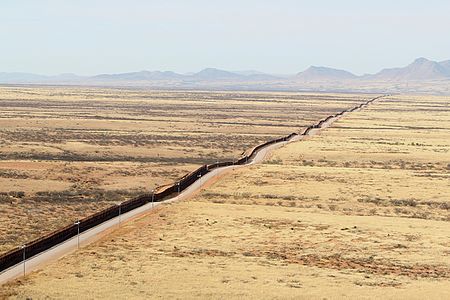
The Illegal Immigration Reform and Immigrant Responsibility Act authorized an increase in the number of Border Patrol agents and support personnel. The constabulary directed new fencing be congenital along the border at areas where most illegal crossings occurred and specifically set aside $12 one thousand thousand for a triple-layer fence in the area nearly San Diego, California. It also directed improvements to exist fabricated to border equipment and applied science and required border crossing documents to include biometric identifiers such as fingerprints. Nether the constabulary, individuals attempting to cross the edge illegally were subject to a fine of $250, and those who flee enforcement checkpoints at high speed were subject field to upwardly to five years in prison.[3] [4]
The law authorized an increase in the number of personnel at the Immigration and Naturalization Service (INS) for the purpose of investigating visa overstays, violations of immigration law by employers, and homo smuggling. Information technology required 10 INS agents to be assigned to each land. The law also allowed the United States attorney general to enter into agreements with state officials to allow them to carry out certain duties of immigration enforcement, including the investigation, anticipation, or detention of individuals residing in the country without legal permission.[3] [4]
Human smuggling and document fraud
The Illegal Clearing Reform and Immigrant Responsibility Act gave the INS wiretapping authority for investigations related to human smuggling or document fraud. These offenses, if done for fiscal gain, were also added to the listing of offenses considered federal racketeering. The law also increased criminal penalties for human being smuggling and established criminal and civil penalties for offenses such every bit false citizenship claims and unlawful voting.[3] [4]
Removal procedures
Nether the Illegal Immigration Reform and Immigrant Responsibility Act, individuals residing in the state without legal permission for between 180 days and 365 days were prohibited from reentering legally for iii years. Those residing in the state without legal permission for more than one year were prohibited from reentering legally for 10 years. Battered women and children were exempted from this provision.[iii] [4]
The law too established a process for expedited removal, by which an INS officer, rather than an immigration gauge, may order the removal of an individual. This expedited procedure applied to individuals at a port of entry and those unable to show that they had been residing in the state continuously for two years. Individuals intending to use for asylum were exempted from this provision.[3] [4]
Prior to the Illegal Immigration Reform and Immigrant Responsibility Deed, non-citizens eligible for removal were allowed to suit their statuses to permanent residency if they had resided in the U.s.a. for at least seven years and had no criminal tape, and if their removal would cause undue hardship for a U.S. citizen or permanent resident immediate relative. The act eliminated this provision of immigration law and replaced it with two new procedures:[iii] [4]
- Permanent residents who had been ordered removed could suspend their removal if they had held a Green Card for five years, had resided continuously in the country for seven years every bit a permanent resident, and had no felony convictions.
- Non-citizens residing in the United states of america on temporary visas could suspend their society of removal if they had resided in the land for 10 years, had demonstrated skillful moral character, had not been bedevilled of a serious law-breaking, and could demonstrate that their removal would cause undue hardship for a U.S. citizen or permanent resident immediate relative.
Only 4,000 of these removal suspensions were allowed annually.
The constabulary also amended the process for voluntary removal, by which a removable non-citizen voluntarily departs the state. Nether the law, to be eligible for voluntary removal, an individual must take been residing in the country for at least i year, must have demonstrated skillful moral character for at least five years, was not removable for i of several specific reasons, and had the means and intent to depart the land voluntarily.[iii] [four]
Refugees, aviary, and parole
The Illegal Immigration Reform and Immigrant Responsibility Human activity created a new claim for refugee or asylum status based on forced abortion or sterilization and immune ane,000 such claims to be accustomed annually.[iii] [iv]
The police force also amended the process for applying for asylum. It made ineligible for asylum individuals who could exist removed to a 3rd country without threat and with access to fair asylum procedures. Individuals applying for asylum were required to exercise so within one year of arriving in the United States. Denied applicants were not allowed to reapply unless they could demonstrate changed circumstances. The constabulary required final decisions on asylum applications to exist fabricated within half dozen months and authorized the addition of 600 aviary officers for the purpose. Asylum officers were required to make a decision apparent fearfulness of persecution when evaluating aviary applications.[3] [iv]
For humanitarian parole from removal, the standard by which such parole was granted was amended from "for emergent reasons or for reasons deemed strictly in the public interest" to "on a case-past-case footing for urgent humanitarian reasons or significant public benefit."[3] [4]
Other provisions
- The police established three pilot programs for employment eligibility verification and exempts from liability employers who made a good faith effort to verify the legal status of employees. It also required employees accusing employers of clearing-related discrimination to evidence that the employer intended to discriminate when asking for more documentation proving eligibility.
- The police force increased the fee for individuals with expired legal status who desire to switch to permanent residency from $650 to $1,000.
- The law allowed sure battered non-citizens eligible for public benefits, allowed states to deny driver'southward licenses to individuals residing in the country without legal permission, made such individuals ineligible for social security benefits, and made such individuals ineligible for in-state college tuition rates.
- Added requirements for affidavits of support from sponsors of legal immigration applicants, including making such affidavits legally enforceable against the sponsor, requiring sponsors to exist adult U.S. citizens or permanent residents, and requiring sponsors to earn incomes of at least 125 percentage of the federal poverty level.
Debate
Much of the debate surrounding the Illegal Clearing Reform and Immigrant Responsibility Human action focused on the provisions related to the removal of individuals residing in the state without legal permission.
Supporters of the constabulary argued that the removal provisions, specially the expedited removal procedure, made the process of removal more efficient, which was benign for ii reasons. Beginning, supporters argued that the expedited process shorted the fourth dimension that individuals were held in detention, a favorable issue of the law since violations of immigration constabulary are not criminal offenses. Since the expedited process applied primarily to individuals apprehended at the edge, supporters contended that it made sense to subject such individuals to a more streamlined process than individuals who had been settled in the country for a long flow of time. 2nd, supporters of the constabulary argued that subjecting some individuals to a more expedited process would lower overall costs of enforcement for the federal authorities.[5]
Opponents of the law argued that, overall, its removal provisions increased immigration detentions and deportations and expanded the offenses for which an individual could be detained and deported. Opponents argued that this policy had the effect of disrupting families of long-term residents of the United States. Regarding the expedited removal process in item, opponents of the police argued that the process denied meaningful consideration of asylum applications. They also allege that such asylum applications were sometimes ignored by the Border Patrol officers administering the expedited removal process.[6]
Come across also

External links
- Full text of the Clearing Reform and Immigrant Responsibility Deed
Footnotes
- ↑ Human Rights Scout, "Deportation Law Based on Criminal Convictions After 1996," accessed March xx, 2017
- ↑ Note: This text is quoted verbatim from the original source. Any inconsistencies are owing to the original source.
- ↑ three.00 3.01 3.02 3.03 3.04 3.05 3.06 3.07 3.08 three.09 three.10 Congress.gov, "H.R.3610 - Omnibus Consolidated Appropriations Human activity, 1997," March 19, 2017
- ↑ 4.0 4.1 4.2 4.3 4.4 iv.five 4.half-dozen 4.seven 4.8 4.9 Siskind Susser PC, "IIRIRA 96 – A SUMMARY OF THE NEW IMMIGRATION BILL," Nov 30, 1996
- ↑ Hoover Institution, "Shifts In The US Clearing Enforcement Organization," July 14, 2015
- ↑ Human Rights Watch, "US: 20 Years of Immigrant Abuses," April 25, 2016
| Ballotpedia | |
|---|---|
| About | Overview • What people are saying • Back up Ballotpedia • Contact • Contribute • Chore opportunities |
| Executive: Leslie Graves, President • Gwen Beattie, Chief Operating Officer • Ken Carbullido, Vice President of Election Product and Engineering science Strategy Communications: Megan Brownish • Abigail Campbell • Sarah Groat • Lauren Nemerovski Contributors: Scott Rasmussen | |
| Editorial | Geoff Pallay, Editor-in-Master • Daniel Anderson, Managing Editor • Ryan Byrne, Managing Editor • Cory Eucalitto, Managing Editor • Mandy Gillip, Managing Editor • Jerrick Adams • Victoria Antram • Dave Beaudoin • Jaclyn Beran • Marielle Bricker • Kate Carsella • Kelly Coyle • Megan Feeney • Nicole Fisher • Juan García de Paredes • Sara Horton • Tyler King • Doug Kronaizl • Amee LaTour • David Luchs • Brittony Maag • Roneka Matheny • Andrew McNair • Jackie Mitchell • Elisabeth Moore • Ellen Morrissey • Mackenzie Murphy • Samantha Mail • Paul Rader • Ethan Rice • Myj Saintyl • Maddie Sinclair Johnson • Abbey Smith • Janie Valentine • Caitlin Vanden Boom • Joel Williams • Samuel Wonacott • Mercedes Yanora |
cousinshurstoill00.blogspot.com
Source: https://ballotpedia.org/Illegal_Immigration_Reform_and_Immigrant_Responsibility_Act_of_1996
0 Response to "Illegal Alien or Immigrant the Politics of Immigration Reform Review"
Post a Comment