Gigabyte Radeon Rx 560 Gaming Oc 4gb Review
Our Verdict
Radeon RX 560 doesn't outperform its predecessor by as much as we expected. Still, it's yet a fairly cool, adequately quiet card that serves upwards modest frame rates at 1920x1080 in modern games, so long as you're willing to dial quality back to Medium presets.
For
- Compelling 1080p performance at reduced detail settings
- Manageable heat/power consumption
- Radeon RX 560 4GB is reasonably priced if you find a $120 menu
Against
- Comparable performance from GeForce GTX 1050 in nigh games
- Higher power consumption than GTX 1050
Tom's Hardware Verdict
Radeon RX 560 doesn't outperform its predecessor by every bit much as we expected. However, it's still a fairly cool, adequately tranquillity bill of fare that serves up modest frame rates at 1920x1080 in modern games, so long as you're willing to dial quality back to Medium presets.
Pros
- +
Compelling 1080p performance at reduced particular settings
- +
Manageable heat/power consumption
- +
Radeon RX 560 4GB is reasonably priced if you discover a $120 card
Cons
- -
Comparable performance from GeForce GTX 1050 in most games
- -
Higher power consumption than GTX 1050
AMD Radeon RX 560 4GB: Polaris eleven Rides Again
AMD's Radeon RX 500-series refresh was a quick blitz of by and large recycled GPUs and iterative nomenclature. But there were a couple of developments that made the 500-series notably more competitive than the Radeon RX 400s earlier them.
For instance, we got a first gustation of Polaris 12, code-named Lexa, in our Radeon RX 550 2GB Review. That GPU was designed to make full a gap under $100 (£120) where entry-level favorites like Radeon R7 260 and 360 one time lived. Information technology, along with Nvidia's competing GeForce GT 1030, were welcome additions to a long-neglected segment.
Just higher up the RX 550 in its refreshed product stack, AMD unveiled a Radeon RX 560 that too piqued our involvement. Terminal twelvemonth, nosotros identified the Radeon RX 460 as a clear step up from previous-gen Bonaire-based cards and Nvidia'southward GeForce GTX 750 Ti. Radeon RX 560 takes the same Polaris 11 GPU, enables all of its shading/texturing resources, increases its clock charge per unit, and (theoretically) lowers its toll.
If the RX 460 was already a potent pick for Hard disk gaming, nosotros couldn't look to come across how Radeon RX 560 improved upon information technology.
Run into Radeon RX 560: More than Shaders; Higher Clocks
When Radeon RX 460 launched more than a year agone, nosotros hadn't seen a new mainstream GPU from AMD in years. Until then, everything was repackaged starting time- and 2nd-generation GCN designs. Naturally, though, the shift to 14nm FinFET inherently meant new processors, even if they shared a lot of architectural attributes with their predecessors. Now the company is massaging its first wave of Polaris GPUs to better situate them confronting a full portfolio of Pascal-based competition.
Compared to Polaris 10, composed of v.7 billion transistors on a 232 mm² die, Radeon RX 560's processor packs three billion transistors into 123 foursquare millimeters of dice infinite. Information technology's similarly based on AMD's fourth-gen GCN architecture, but rebalanced for more than power-sensitive applications.
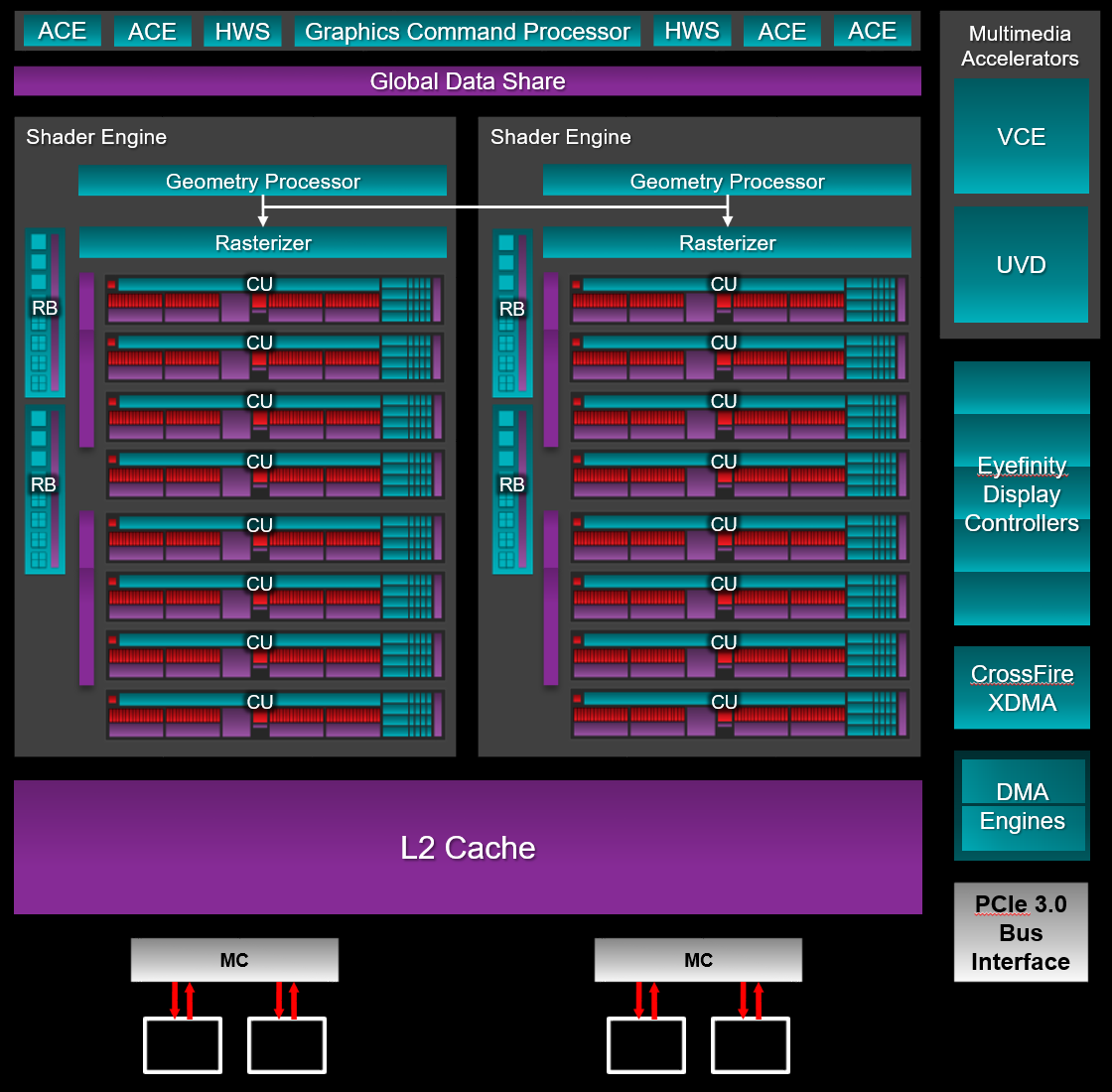
A unmarried Graphics Command Processor up front is nonetheless responsible for dispatching graphics queues to the Shader Engines. So too are the Asynchronous Compute Engines tasked with treatment compute queues. As with Polaris 10, this scrap's command processing logic consists of four ACEs, with 2 Hardware Scheduler units in place for prioritized queues, temporal/spatial resource management, and offloading CPU kernel mode commuter scheduling tasks. While many resources are trimmed moving from Polaris 10 to xi, this is not one of them.
Shader Engines, on the other hand, are halved—Polaris 11 gets two, compared to Polaris 10's four. But whereas the version of Polaris 11 that went into Radeon RX 460 featured seven agile Compute Units per SE, Radeon RX 560 gets a completely uncut GPU sporting sixteen total CUs. Given 64 Stream processors and four texture units per CU, the math for Radeon RX 560 adds upward to 1024 shaders and 64 texture units across the GPU—a ~14% increase.
| AMD Radeon RX 560 | Asus ROG Strix RX 560 O4GB Gaming | Nvidia GeForce GTX 1050 | Nvidia GeForce GTX 1050 Ti | |
|---|---|---|---|---|
| GPU | Polaris 11/Baffin | Polaris eleven/Baffin | GP107 | GP207 |
| Shaders | 1024 | 1024 | 640 | 768 |
| Base Clock Frequency | 1175 MHz | 1221 MHz | 1354 MHz | 1290 MHz |
| Boost Clock Frequency | 1275 MHz | 1326 MHz | 1455 MHz | 1392 MHz |
| Retention Size & Type | 4GB GDDR5 | 4GB GDDR5 | 2GB GDDR5 | 4GB GDDR5 |
| Process Applied science | 14nm | 14nm | 14nm | 14nm |
| Transistors | iii Billion | 3 Billion | 3.3 Billion | 3.3 Billion |
| Texture Units | 64 | 64 | 40 | 48 |
| Texture Fillrate | 81.6 GT/s | 84.nine GT/southward | 58.2 GT/s | 66.8 GT/south |
| ROPs | 16 | xvi | 32 | 32 |
| Pixel Fillrate | 20.4 GPix/s | 21.2 GPix/s | 46.6 GPix/southward | 44.5 GPix/due south |
| Retentiveness Bus | 128-scrap | 128-bit | 128-bit | 128-bit |
| Retentivity Clock Frequency | 3500 MHz | 3500 MHz | 3504 MHz | 3504 MHz |
| Memory Bandwidth | 112 GB/s | 112 GB/due south | 112.1 GB/s | 112.1 GB/s |
| TDP | 80W | 80W/100W | 75W | 75W |
Ii return back-ends per Shader Engine, each with four ROPs, full 16 pixels per clock, or, again, half of what you go from Radeon RX 580/570. Polaris xi's memory bus is also cutting in half to 128 bits. AMD tries to compensate somewhat with vii Gb/s GDDR5, only even then, you're only looking at 112 GB/s of bandwidth. This spec is unchanged from the Radeon RX 460.
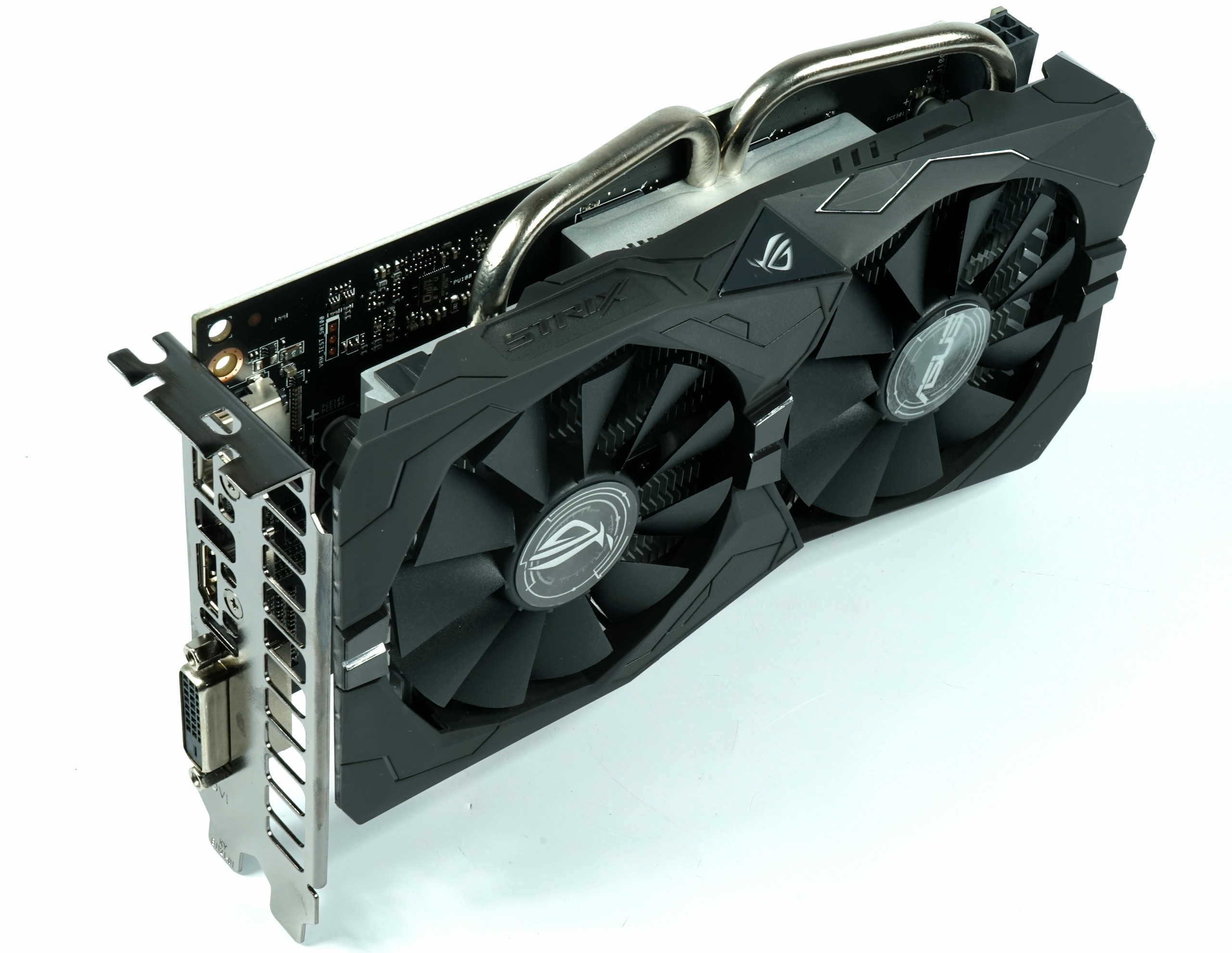
In that location are higher GPU clock rates to talk about, though. AMD specifies a base frequency of 1175 MHz and a Boost ceiling of 1275 MHz. The visitor sent our U.S. and German labs Asus' ROG Strix Radeon RX 560 O4GB Gaming OC Edition to test, which is overclocked to a 1326 MHz Boost frequency in Gaming manner.
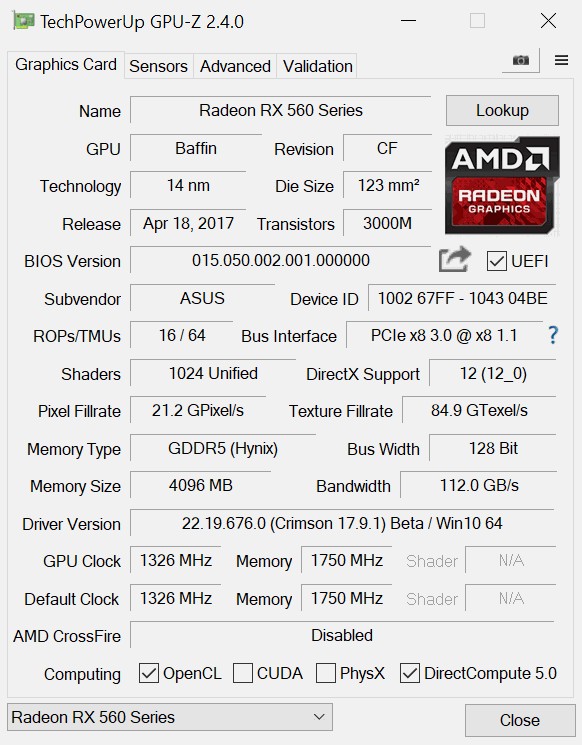
Interestingly, while the Radeon RX 460 was officially rated under 75W, opening the door to implementations without auxiliary power, all of the boards we tested had 6-pin connectors. For its higher-clocked Radeon RX 560, AMD cites a typical board ability of 80W. And yet, nosotros've already seen versions with no ability connector and higher-than-reference clock rates. Our Asus cards practise, however, come equipped with vi-pivot inputs.
More: Best Graphics Cards
More: Desktop GPU Functioning Bureaucracy Tabular array
MORE: All Graphics Content
cousinshurstoill00.blogspot.com
Source: https://www.tomshardware.com/reviews/amd-radeon-rx-560-4gb,5254.html
0 Response to "Gigabyte Radeon Rx 560 Gaming Oc 4gb Review"
Post a Comment